

The government on Friday raised interest rates on most post office saving schemes by up to 0.7 per cent for the April-June 2023 quarter in line with the firming of interest rates in the economy. While the interest rates for popular PPF and savings deposits have been retained at 7.1 per cent and 4 per cent, respectively, there has been an increase between 0.1 per cent and 0.7 per cent in other saving schemes, a finance ministry statement said. The highest increase was in the interest rate of the National Savings Certificate (NSC), which will now attract 7.7 per cent, up from 7 per cent, for the April 1 to June 30, 2023 period.

Exactly a fortnight ahead of the Reserve Bank of India's (RBI's) next monetary policy review, a key market indicator of interest rates - the overnight indexed swap (OIS) - suggests that the central bank may tighten policy by 35 basis points and then refrain from further rate hikes. RBI Deputy Governor Michael Patra recently described the OIS as the primary instrument for hedging interest rate risk in India. The six-member Monetary Policy Committee (MPC) of the RBI will meet on December 5-7.

Due to tight liquidity condition, RBI would cut cash reserve ratio.

The country's largest lender State Bank of India has raised its marginal cost of funds based lending rate by 10 basis points or 0.1 per cent across all tenures, a move that will lead to an increase in EMIs for borrowers. This is the second hike in a month raising the cost by 0.2 per cent with the two consecutive increases. The revision follows an off-cycle rate increase by the Reserve Bank earlier this month. The central bank hiked the repo rate -- at which it lends short term money to banks -- by 0.40 per cent to 4.40 per cent.

Retail investors could be hesitant to invest in floating rate savings bonds, as these specific bonds tend to be profitable only in a rising rate environment, according to market participants. The Reserve Bank of India has allowed subscriptions for floating-rate savings bonds, 2020, via retail direct - an online portal that enables individual investors to purchase government securities.

Industry houses are emphatic with the RBI pruning repo rate and CRR by 0.25 per cent each after a long nine months in its third quarter monetary policy review.
The central bank has hiked however reverse repo rate by 0.25 per cent.

The new rates vary from 8.80 to 9.05 per cent on various slabs of loans.

Net NPAs increased to Rs 36,260 crore in the December quarter from Rs 34,843 crore in September and Rs 33,116 crore in December 2023, observes Tamal Bandyopadhyay.
Two days after the repo rate cut, the Reserve Bank of India governor Bimal Jalan on Monday said the soft interest rate bias will continue.
With interest rates rising there are doubts if teaser rate home loans offered by banks will come to an abrupt halt.

The need for money among banks, especially for short-term funds, may turn more intense in the last month of the financial year to feed the demand for capital for tax payments and meet year-end targets. The mobilisation of funds via the certificate of deposits (CDs) has seen a threefold increase to over Rs 60,000 crore in the fortnight that ended February 23 from around Rs 20,000 crore in the fortnight of January 26, 2024, according to the Reserve Bank of India (RBI) data.

Analysts feel the RBI should not opt for another hike in the calendar year.
RBI Governor D Subbarao aims to revive growth by increasing the flow of credit through reduction in policy rates. By reducing the repo rate by another 25 basis points, he is hinting at a further reduction in interest rates. And, through the 25 bps cut in reverse repo rate, he is trying to make it less remunerative for banks to park surplus liquidity with the central bank and instead prodding them to lend more to the productive sectors.

Reserve Bank Governor Shaktikanta Das on Friday said that this stage would have been "premature" and "very very risky" as the retail inflation is still high, and future monetary policy action would depend upon the income data and outlook. Earlier this month, the RBI continued to maintain the status quo in the short-term lending interest rate (repo), citing inflationary concerns, though it changed the monetary policy stance to neutral.

The central bank had nudged banks to cut lending rates.
RBI ups inflation target to 7 per cent from 6 per cent projected earlier.

Review your family emergency fund and replenish it if needed. Revisit financial goals to see if there is any change in timeline or the corpus required.
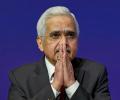
Outgoing Reserve Bank Governor Shaktikanta Das said on Tuesday that restoring inflation-growth balance is the most important task ahead of the central bank. Addressing a press conference on his last day as the central bank chief, Das said his successor will have to navigate the changing world order, effectively deal with cyber threats, and focus on harnessing new technologies.

'I think today RBI supervision is much sharper than what it was earlier.'

Declining price of vegetables pulled down inflation to over three-year low of 5.96 per cent in March, core inflation moderated to 3.5 per cent and food price inflation also eased to 8.2 per cent, which is likely to prompt the RBI to consider a rate cut in its annual monetary policy next month.
With RBI's repo rate cut and strong macroeconomic fundamentals like benign inflation, strong forex reserves and stable rupee, GDP growth is expected to be higher and interest rates are poised to touch new lows, PNB Gilts has said.

P K Mishra, a retired IAS officer of the Gujarat cadre, is currently serving as the principal secretary to the prime minister.
Cash Reserve Ratio (CRR) is the amount of funds that the banks have to keep with the Reserve Bank of India. If RBI decides to increase the percent of this, the available amount with the banks comes down. RBI is using this method (increase of CRR rate), to drain out the excessive money from the banks.
HDFC Bank has hiked its benchmark prime lending rate (BPLR) by 0.25 per cent to 15.25 per cent with immediate effect.

Floating-rate mutual funds are back in demand after a year-long period of consistent outflows. In the past three months, investors have poured over Rs 6,100 crore into these debt schemes, indicating a reversal in fortunes for the category that recorded outflows for 11 consecutive months (May 2022 to March 2023), totalling Rs 32,250 crore. Floating-rate funds invest at least 65 per cent in floating-rate instruments, which have their interest rates linked to the Reserve Bank of India repo rate.
Amid speculations that home and personal loan rates may go up, government said on Wednesday the 0.25 per cent hike in Reserve Bank of India's short term lending rate is not intended to make loans costlier but to make banks self sufficient.
ICICI Bank, the second-largest private sector lender and state-owned Indian Bank on Monday raised their lending rates across all tenors in anticipation of a rate hike by the RBI later this week. The rates have been increased across all tenors under the marginal cost of funds-based lending rate (MCLR) system, a move that will make EMIs expensive for those who availed loans benchmarked against the MCLR. Under the revised rates, effective August 1, ICICI Bank's one-year MCLR has increased by 15 basis points or 0.15 per cent to 7.90 per cent, while the overnight MCLR rose to 7.65 per cent, as per information posted on the bank's website.

Encouraged by softening inflation, the RBI on Thursday decided to cut the benchmark interest rate by 0.25 per cent to 7.75 per cent with a view to boost growth.

'Growth, liquidity and deposit mobilisation are likely to be discussed during the interaction.'
The Reserve Bank of India has directed banks to set aside more capital to cover risks on advances to realty sectors and has raised repo rate by 0.25 per cent to 7.50 per cent .

Benchmark equity indices Sensex and Nifty pared early gains to settle lower on Wednesday due to late selling in index major Reliance Industries, ITC and HDFC Bank even as the RBI took the first step towards a rate cut in its monetary policy review. Erasing its early gains, the 30-share BSE Sensex fell 167.71 points or 0.21 per cent to close at 81,467.1. During the day, it surged 684.4 points or 0.83 per cent to hit an intra-day high of 82,319.21.

"In view of the festival season and extending the benefits to customers across all segments, we have reduced our MCLR by 10 bps across all tenures," the bank said in a statement.

'When you need to revive the economy, when you need to revive aggregate demand, you cut taxes.' 'But what's this government doing?' 'It's increasing taxes for the middle class and the vast majority of the poor on fuel, which has a ratchet effect on most other products.'

The bank kept cash reserve ratio unchanged at 6 per cent.

The Reserve Bank on Friday said India is poised to become the growth engine of the world as it retained the GDP projection for the current fiscal at 6.5 per cent. Unveiling the bi-monthly monetary policy review, Reserve Bank of India (RBI) Governor Shaktikanta Das said the domestic economy exhibits resilience on the back of strong demand.
